

Getting the right insurance as a Florida contractor is harder than it should be, especially when you’re dealing with Chapter 489 licensing requirements, a hardened market after back-to-back hurricane seasons, and workers’ comp costs that can feel completely disconnected from your actual risk level.
After reviewing dozens of carriers and brokers serving Florida’s construction trades, the clearest pattern was this: the right coverage partner makes compliance easier and keeps your business protected when things go sideways.
This guide breaks down five options worth knowing, from specialty brokers to major carriers.
The shortlist methodology
Each option was assessed using publicly available sources, including official company websites, industry review platforms, ratings databases, and case study records. Only providers with a proven track record in contractor insurance coverage made the cut. The goal was practical, not exhaustive.
→ See the full research breakdown
- Affordable Contractors Insurance – Best for small to mid-sized contractors needing fast, compliant coverage
- Markel – Best for specialty and hard-to-place contractor insurance
- AmTrust Insurance – Best for small business and contractor workers’ compensation insurance
- Zurich – Best for commercial property-casualty insurance for mid-sized and enterprise businesses
- biBerk – Best for small business and contractor insurance
How Insurance for Florida Contractors Shapes Business Outcomes
Picking the wrong coverage isn’t just a paperwork problem. It can cost you a license suspension under Florida Statute 489, leave you exposed on a job site after a hurricane, or saddle your crew with workers’ comp premiums that don’t reflect your actual safety record.
Florida’s construction market is genuinely tough to work in. Coastal zone underwriting restrictions, high-risk trade classifications, and a market still recovering from major storm losses have all pushed premiums higher and made some coverage types harder to find.
That’s why the provider you choose matters beyond just price. A carrier or broker with real contractor insurance experience understands general liability limits (think $1M per occurrence and $2M aggregate as a baseline), knows how your experience modification rate affects workers’ comp pricing, and can help you manage claims frequency before it shows up in your renewal.
The right fit protects your license, your crew, and your bottom line.
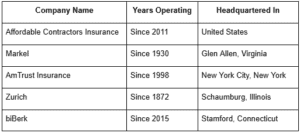
Top 5 Insurance Options for Florida Contractors: Specs at a Glance
Note: All data in this table is sourced from review platforms and the official websites of the listed companies.
Affordable Contractors Insurance – Best for Small to Mid-Sized Contractors Needing Fast, Compliant Coverage
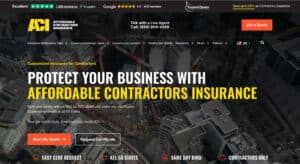
Where Does Affordable Contractors Insurance Focus Its Operations?
Affordable Contractors Insurance is a U.S.-based brokerage built around the needs of contractors and construction businesses. They cover general liability, workers’ compensation, commercial auto, builder’s risk, tools and equipment, and umbrella liability. Their client base spans roofers, electricians, plumbers, HVAC contractors, and remodelers. The standout feature is their same-day policy binding and rapid certificate of insurance turnaround, which matters a lot when a job is waiting and you need proof of coverage fast.
What’s Affordable Contractors Insurance’s Real Advantage for Insurance for Florida Contractors?
The real problem they solve is time-sensitive compliance. Florida-licensed contractors often need certificates the same day a project kicks off, and most general brokers can’t move that fast. Their contractor-only focus since 2011 means they’ve built the workflows and carrier relationships to actually deliver on that promise.
What Real Customers Report:
From what the reviews show, contractors tend to flag two things consistently: the speed of the process and the straightforward pricing. The fact that they’ve been doing this since 2011 with a narrow focus on trade contractors gives the experience a level of reliability that’s hard to match when you’re dealing with a last-minute COI request.
Markel – Best for Specialty and Hard-to-Place Contractor Insurance

Where Does Markel Focus Its Operations?
Markel runs three divisions: Markel Specialty, Markel International, and Markel Global Reinsurance. For contractors, the most relevant piece is their specialty property and casualty coverage, particularly for complex or hard-to-place risks that standard carriers won’t touch. They work across construction, healthcare, energy, and transportation with 76 offices in 18 countries. If you’re a Florida contractor with a tricky risk profile (think coastal roofing or high-value commercial builds), Markel actually has options.
What’s Markel’s Real Advantage for Insurance for Florida Contractors?
Where most carriers draw the line on unusual or high-exposure contractor risks, Markel’s specialty underwriting model keeps going. Their flexible underwriting approach, combined with decades of construction industry experience, means they can put together coverage structures that a standard admitted carrier simply won’t offer.
What Real Customers Report:
Markel has earned the Feefo Platinum Trusted Service award for six consecutive years (not cheap to maintain, but it reflects genuine review volume), which signals consistent performance over time. Industry recognition from the British Insurance Awards and Insurance Times Awards backs up the idea that their track record holds up under scrutiny. For a specialty carrier, that kind of consistency is rare.
AmTrust Insurance – Best for Small Business and Contractor Workers’ Compensation Insurance
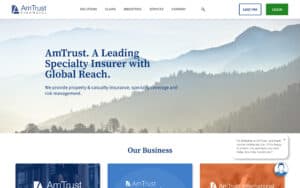
Where Does AmTrust Insurance Focus Its Operations?
AmTrust Financial Services has been writing insurance since 1998 and has grown into the third-largest workers’ compensation provider in the country. They focus on small commercial businesses, particularly in low-to-medium hazard classes, which maps well onto a lot of Florida’s specialty trade contractors. Their product range covers workers’ comp, general liability, business owners policies, cyber liability, and employment practices liability. The AmTrust Genius platform is worth noting for how it speeds up the quoting process.
What’s AmTrust Insurance’s Real Advantage for Insurance for Florida Contractors?
For Florida contractors where workers’ comp costs are often the single biggest insurance line item, AmTrust’s scale and specialization in small commercial workers’ compensation gives them real pricing and underwriting depth. Their claims track record (including a 5-Star Claims Excellence Award from Insurance Business America in 2025) means that when something does go wrong on a job site, the claims process is less of a battle.
What Real Customers Report:
AmTrust carries an A- (Excellent) rating from AM Best, which is the kind of financial stability signal that matters when you’re locking in a multi-year coverage relationship. Customers in the small business and contractor space consistently point to responsive claims handling and accessible digital tools as the two things that keep them renewing. That said, they’re best suited for low-to-medium hazard classifications (not high-risk roofing or demolition at scale).
Zurich – Best for Commercial Property-Casualty Insurance for Mid-Sized and Enterprise Businesses

Where Does Zurich Focus Its Operations?
Zurich North America has been writing commercial insurance since 1872 and brought that operation to North America in 1912. They cover commercial property and casualty, auto dealership insurance, life insurance, accident and health products, and crop insurance. Their client base skews toward mid-sized and large businesses, with 90% of Fortune 500 companies in their book. For Florida contractors running larger commercial operations, Zurich brings both the capacity and the experience to handle complex, high-value risk programs.
What’s Zurich’s Real Advantage for Insurance for Florida Contractors?
The problem Zurich solves best is managing multiple large projects at once. When a Florida contractor is juggling several big jobs and needs a carrier with the financial depth and underwriting flexibility to cover all of it, Zurich’s track record and capacity become a real differentiator. A Transactional Net Promoter Score of 82 against an industry average of 36 is a signal that their claims and service experience holds up, which is where most carriers lose clients.
What Real Customers Report:
The consistent theme in Zurich customer feedback is reliability over time. Over 150 years of claims experience is not a marketing line when you’re a Florida contractor filing after a major storm. Mid-sized and larger operations tend to value Zurich’s structured approach to complex risk most. Smaller contractors might find the experience a bit more enterprise-focused than they need (think corporate pricing and process).
biBerk – Best for Small Business and Contractor Insurance
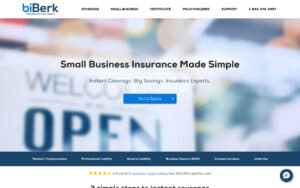
Where Does biBerk Focus Its Operations?
biBerk launched in 2015 as a direct-to-consumer small business insurer under the Berkshire Hathaway Insurance Group umbrella. They write workers’ compensation, commercial auto, general liability, professional liability, and cyber insurance, covering the policies most contractors need from day one. With over 200,000 customers, their model cuts out the broker middleman entirely, which is where the savings come from. For smaller Florida contractors who know what they need and want to get covered without a long back-and-forth, biBerk is built for exactly that.
What’s biBerk’s Real Advantage for Insurance for Florida Contractors?
The direct model is what sets them apart. biBerk claims savings of up to 20% versus traditional brokered policies, and with Berkshire Hathaway backing (A++ AM Best rating across subsidiaries), you’re not trading financial stability for the lower price. For a small Florida contractor trying to hit required coverage limits without blowing the budget, that combination of cost and credibility is genuinely useful.
What Real Customers Report:
Customers consistently point to the simplicity of the buying process as biBerk’s biggest win. The online platform is built for people who don’t want to spend hours on the phone explaining their business to an agent. The Berkshire Hathaway A++ rating is the reassurance most contractors need to feel confident about skipping the traditional broker route. The tradeoff is that complex or specialty risks may need more customization than their direct platform offers.
How These Options Were Tested and Ranked
Building this list started with a broad sweep rather than a narrow search. Directories, trade association resources, industry review platforms, and official company websites were all pulled into the initial pool. The goal at this stage was to capture any provider with a plausible claim to serving Florida contractors, not to pre-filter too aggressively.
Scope of Information Required at the Outset
The starting point was assembling a longlist from multiple source types: state-specific contractor insurance directories, national insurance review aggregators, trade publication features, and carrier comparison databases. Each provider needed to show up across more than one source type before making it onto the working list. Single-source entries were noted but not automatically included.
Vetting Requirements
From the longlist, the next pass removed providers that lacked verifiable public records or showed thin review histories. Patterns in customer feedback were analyzed carefully, particularly around claims handling, certificate turnaround, and renewal experience. Providers with scattered or inconsistent review profiles, even if they had strong marketing copy, were set aside in favor of those with more consistent track records.
Confirmation of Facts and Data
Claims made on company websites were cross-referenced against independent review platforms, industry ratings bodies (AM Best among others), and published award records. Where a company claimed a capability (same-day binding, specialty underwriting for hard-to-place risks, workers’ comp scale), that claim needed to be supported by something outside their own site. Data that couldn’t be confirmed was excluded from the published descriptions.
Authority and Reputation Check
Each shortlisted provider was checked for third-party authority signals: named awards from recognized insurance industry bodies, mentions in trade publications, and original published research or reports. Companies that had earned consistent recognition over multiple years scored higher than those with a single award or press mention. The Feefo Platinum recognition that Markel has held for six consecutive years is an example of the kind of sustained, review-based recognition that carried weight in this assessment.
The Insurance for Florida Contractors Evidence Layer
The final filter was about Florida contractor relevance. Each remaining provider was evaluated for dedicated service pages targeting Florida contractors, verified customer reviews from construction trade clients, and any published case studies or coverage examples tied to contractor-specific risks like builder’s risk on coastal sites, high-EMR workers’ comp accounts, or Chapter 489 compliance support. Providers with clear, specific evidence of serving this audience were ranked above generalist commercial insurers with contractor coverage as just one line among many.
How to Match an Insurance Option for Florida Contractors to Your Case
Choosing from this list comes down to knowing what your business actually needs right now, not what sounds most impressive. Here’s how to think through the match.
- Industry/Domain Experience: Look for providers that name your trade (roofing, electrical, HVAC, plumbing) in their coverage descriptions. A carrier that lists “contractors” as a general category is different from one that has underwriting experience with your exact classification code and its risk profile.
- Features and Service Offerings: Match the product lineup to your gaps. If workers’ comp is your biggest exposure, AmTrust’s specialization matters. If you need same-day certificates for a Florida job, Affordable Contractors Insurance’s binding speed is what you need.
- Pricing Structure: Direct carriers like biBerk can cut costs for straightforward risks. Specialty brokers and carriers like Markel may cost more upfront but can place coverage that others won’t touch.
- Results Measurement: Ask any provider how they track your experience modification rate over time and what tools they offer to help you manage claims frequency. That number directly affects your future premiums.
- Industry Knowledge and Compliance: Florida Statute 489 compliance is non-negotiable. Your provider needs to understand what coverage types are required for your license class and be able to document that coverage accurately on certificates.
What to Remember
Florida contractors need more than a generic commercial policy. The right coverage partner understands Chapter 489 requirements, knows how to work around coastal underwriting restrictions, and can move fast when a project demands proof of coverage on short notice.
The five options here cover different needs: fast binding for smaller contractors, specialty placement for hard-to-place risks, workers’ comp depth for trade-heavy operations, and direct-to-consumer simplicity for budget-conscious businesses.
As Florida’s construction market keeps adjusting after recent storm seasons, having a coverage partner with real contractor experience will matter more, not less.